
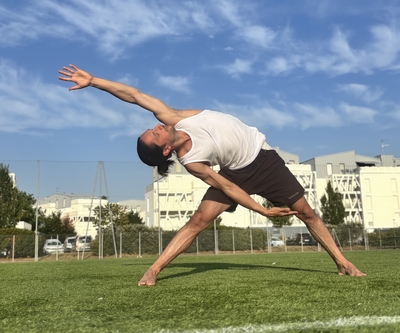
1. Stretching Makes You Weaker
The relationship between stretching and strength loss deserves a nuanced explanation.
Research has shown that muscular performance can decrease after more than 60 seconds of static stretching. This may lead to reductions in force production, neural activation, and tendon stiffness. These effects are largely explained by the activation of the inverse stretch reflex, a protective mechanism that temporarily inhibits muscle contraction to reduce the risk of injury caused by excessive stretching.
However, these findings should be interpreted with caution. First, many studies do not include active-dynamic stretching as part of their warm-up protocols. Second, when stretching duration remains below 60 seconds, the impact on strength performance appears to be minimal.
Avoiding stretching out of fear of losing strength is therefore a misconception. When performed in an active-dynamic manner and incorporated into a structured warm-up, stretching can be an effective preparation tool. It helps improve joint mobility, neuromuscular activation, progressive increases in muscle temperature, and the reactivation of movement patterns.
From this perspective, properly applied stretching is a valuable ally to performance—not its enemy.
2. You Should Always Stretch After Exercise
Yes and no.
Stretching immediately after a high-intensity workout—such as strength training, speed work, or lactate-based sessions—can be problematic. The muscle has already been subjected to significant eccentric loading and fatigue, and aggressive stretching may further aggravate the microdamage created during training. This perspective was notably highlighted by Gilles Cometti in 2003 through his work on post-exercise stretching.
That said, avoiding stretching altogether is not the solution either. Stretching can be highly beneficial when performed away from intense training sessions or during a dedicated mobility session. For example, spending 45 minutes stretching early in the morning can be an excellent way to integrate mobility work into a training plan or a healthy lifestyle routine.
In some situations, gentle comfort-based stretching may also be performed shortly after exercise, provided it remains light, non-intensive, and focused solely on relaxation and muscle recovery.
As with any physical activity, stretching should follow principles of progression and proper preparation. Effective and safe stretching requires appropriate protocols to protect the body and maximize benefits.
3. The Longer You Hold a Stretch, the Better
It is important to distinguish between sports-oriented stretching and traditional movement practices such as yoga.
In yoga, flexibility is not necessarily the final goal. Instead, it serves as a means of preparing the body and mind for deeper states of awareness. As a result, practitioners may hold complex postures for extended periods of time.
In contrast, remaining in a stretching position for hours has little relevance in an athletic context and can even become counterproductive. Nevertheless, during a dedicated flexibility session, holding a stretch for longer than one minute can be entirely appropriate.
Traditional passive stretching remains one of the most widely used methods, and its benefits are well established when applied within a structured program. The objective is not to criticize spontaneous or unplanned stretching, but rather to emphasize that a more organized approach is likely to produce better results.
4. Everyone Should Stretch the Same Way
The answer is no.
Every individual has a unique muscular history, movement profile, and set of physical demands. A one-size-fits-all approach simply does not exist. In practice, fully individualized stretching programs are not always feasible during group sessions.
There are numerous stretching methods, each with its own relevance depending on the activity and objectives involved. These include traditional passive stretching, contract-relax stretching, contract-stretch techniques, passive postures, and Postural Stretching, a method developed by French physiotherapist Jean-Pierre Moreau in the 1960s.
Advanced techniques such as contract-relax stretching are not necessarily suitable for everyone. On the other hand, certain physiological principles consistently support the use of controlled dynamic stretching during warm-ups.
Once again, context and common sense should guide the choice of method.
5. Being Flexible Means Being Healthier
We all have contrasting images in mind: the highly flexible ballet dancer on one side and the seemingly stiff bodybuilder who struggles to touch their toes on the other.
While flexibility is undeniably a valuable physical quality for health, a lack of strength can be an equally significant limitation when it comes to longevity and quality of life. Age-related loss of independence is primarily associated with declining strength levels rather than reduced flexibility, although mobility restrictions should not be overlooked.
Excessive flexibility can also become problematic when it is not supported by adequate strength to maintain joint stability. Excessive ligament laxity can significantly increase the risk of preventable injuries.
In fact, it may be more accurate to speak about functional mobility rather than flexibility alone. Many elite athletes display substantial movement restrictions resulting from the specific mechanical demands of their sport. While common, this should not necessarily be considered ideal.
We would rarely describe a high-level athlete as unhealthy. Yet from a musculoskeletal perspective, the reality can sometimes be surprisingly complex.
Mobility is the result of a delicate balance between flexibility, strength, motor control, coordination, and balance. These physical qualities require dedicated training, but they are often neglected due to time constraints or a lack of perceived importance.
Flexibility alone is not the definition of good health.